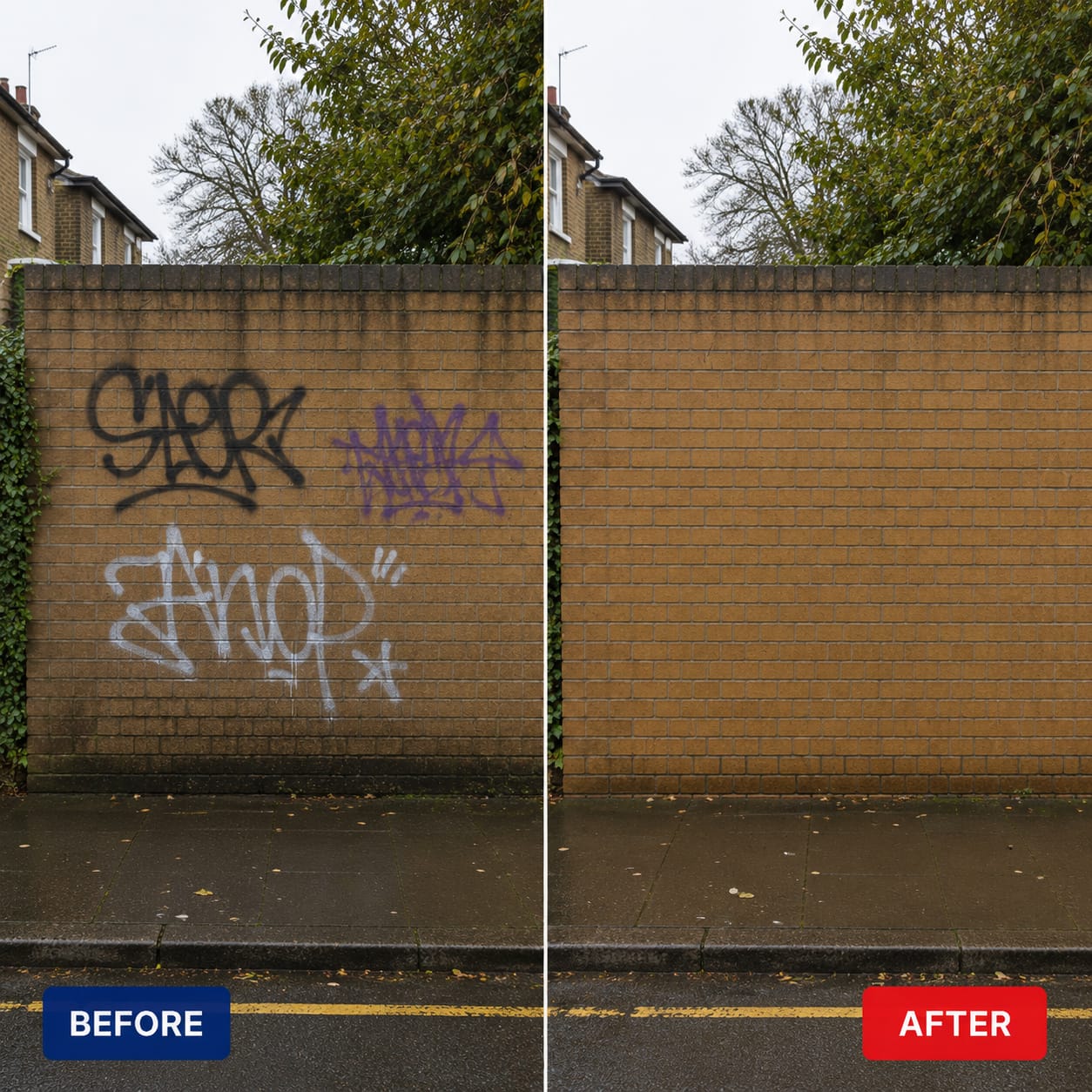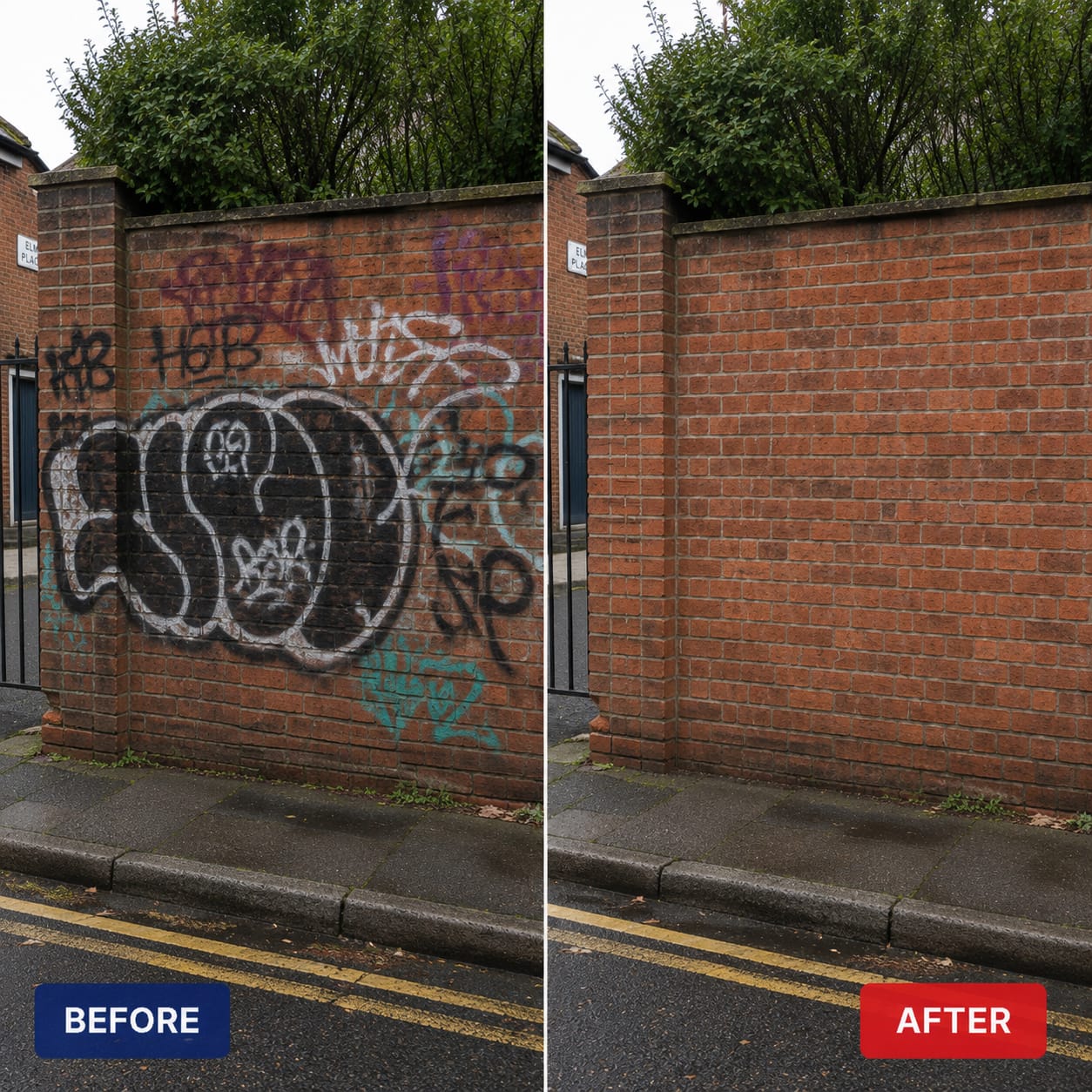
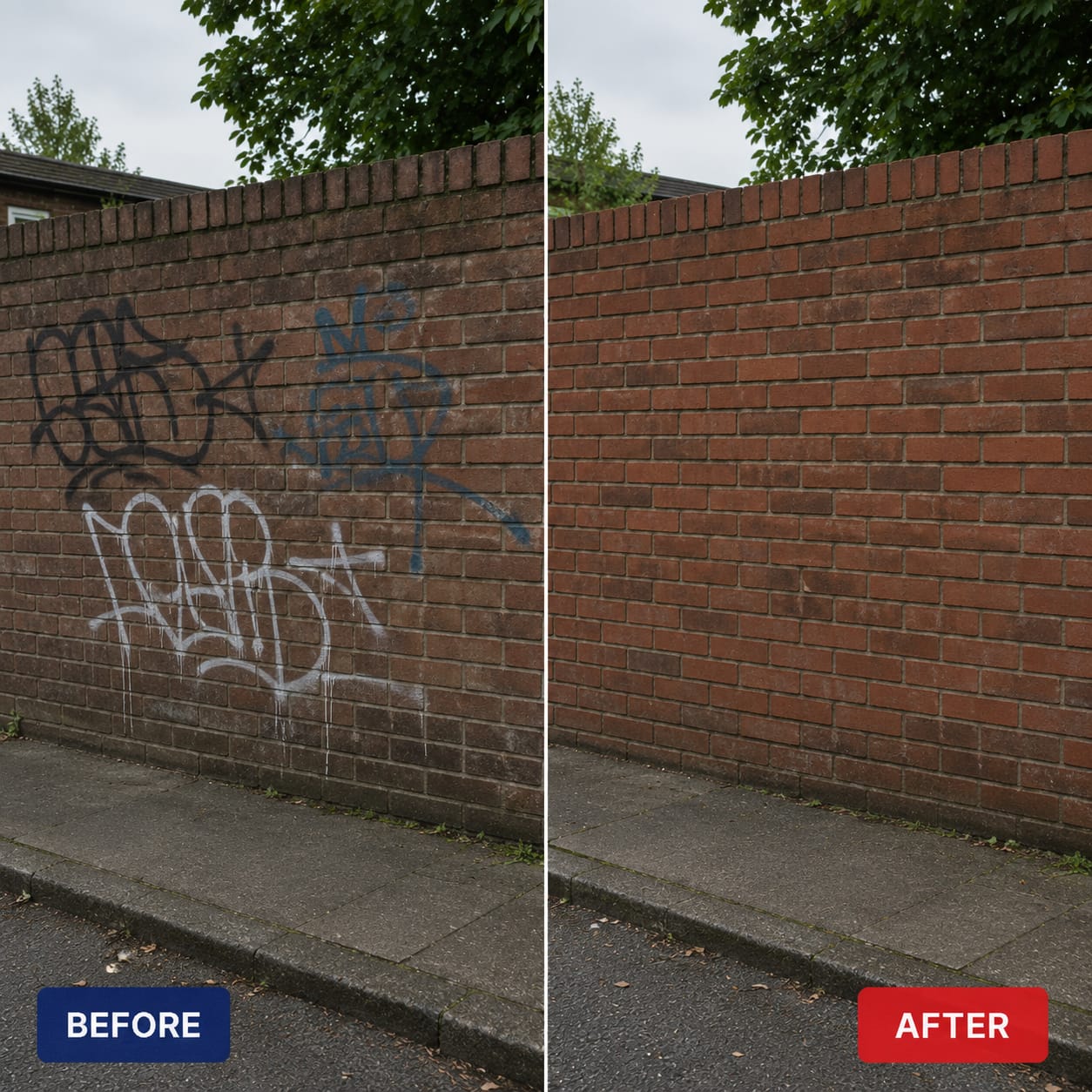
When a wall, shutter or underpass is a regular target, you face a simple choice: keep removing the graffiti each time it appears, or apply a protective coating once and make every future clean quick and cheap.
For anyone watching a maintenance budget, it's worth understanding how the two really compare — on cost, predictability and the surface itself. Here's the honest breakdown.
Quick verdict: for any surface tagged more than once or twice a year, an anti-graffiti coating almost always wins on total cost and hassle. For rarely-hit surfaces, removal-only is fine.
At a glance
| Repeat removal | Anti-graffiti coating | |
|---|---|---|
| Upfront cost | Low per visit | Higher one-off |
| Cost over time | Adds up with every incident | Falls — future cleans are quick & cheap |
| Predictability | Unpredictable, reactive bills | A single planned cost |
| Speed of each clean | Slower — full removal each time | Fast — often just water & low pressure |
| Surface protection | None — repeated cleaning wears it | Protects the surface itself |
| Best for | Rarely-tagged or temporary surfaces | Proven repeat hotspots |
How we compared them
We weighed the two approaches on the factors that actually matter to a budget holder:
- Upfront cost — what you pay to get started.
- Total cost over time — the real figure once repeat incidents are counted.
- Predictability — how easy it is to budget for.
- Surface protection — whether the approach protects or wears the material.
- Suitability — which surfaces and situations each one fits.
The case for removal only
Removal-only feels cheaper because each visit is a small, separate cost. For a surface that's tagged rarely — say once every couple of years — that's genuinely the sensible choice: there's little point coating a wall that's almost never hit.
The weakness shows on repeat targets. Every visit carries call-out, labour and travel costs regardless of how small the tag is, and the total is unpredictable — a bad month of tagging means a string of unplanned bills. Repeated aggressive cleaning also wears the surface over time.
The case for coating
An anti-graffiti coating is a larger one-off cost up front, but it changes every clean that follows. Once a surface is protected, future graffiti lifts off far more easily — often with just water and low pressure — which means faster visits, lower labour and no harsh chemicals.
It also protects the surface itself, which matters on porous or heritage materials. Over a year or two on a frequently-hit wall, the savings on faster, easier cleans typically outweigh the upfront cost — and the budget becomes predictable.
Pros and cons
Repeat removal
- ✓Low cost per visit
- ✓No upfront commitment
- ✓Fine for rarely-tagged surfaces
- ✕Unpredictable, mounting bills
- ✕Slower clean each time
- ✕Repeated cleaning wears the surface
Anti-graffiti coating
- ✓Cheaper over time on hotspots
- ✓Fast, easy future cleans
- ✓Protects the surface itself
- ✓Predictable, one-off cost
- ✕Higher upfront cost
- ✕Sacrificial types need re-applying
- ✕Not worth it for rarely-hit walls
Which is right for your site?
- Rarely-tagged surfaces: removal only — don't pay to coat a wall that's almost never hit.
- Proven repeat hotspots: coating — it pays for itself and makes every future clean easy.
- Porous or heritage surfaces: coating — it protects the material as well as the budget.
- Temporary structures: removal only — no point coating something due to be replaced.
The numbers in practice
Picture a shutter that's tagged roughly once a month. With removal-only, that's around twelve separate call-outs a year — each with its own labour and travel — and a bill that jumps around unpredictably. Coat the same shutter once and those twelve jobs become twelve quick wipe-downs, often just water and low pressure, at a fraction of the time and cost. On a surface hit that often, the coating has usually paid for itself well within the first year; everything after that is saving.
Now picture a wall tagged once every three years. Here the sums flip: the coating might not be recovered before the surface is due other work anyway, so removal-only is the smarter spend. The deciding factor is almost always frequency — which is why a quick honest look at your incident history tells you most of what you need to know.
A note on the surface itself
Cost isn't the only factor. Every removal, however careful, is one more clean the surface has to withstand — and on porous brick, render or heritage stone, repeated cleaning gradually takes its toll. A coating changes that equation: because future tags lift off gently, the material underneath is protected as well as your budget. On sensitive or listed surfaces, that protection alone can justify the coating regardless of tagging frequency.
Frequently asked questions
How long does an anti-graffiti coating last?
It depends on the coating and the surface. Permanent coatings can protect a surface for years from a single application; sacrificial coatings are re-applied after each clean. We'll recommend the right type for your site.
At what point does coating become cheaper than removal?
As a rule of thumb, once a surface is tagged more than once or twice a year the coating usually works out cheaper over time, because every future clean is faster and cheaper. We can help you work out the tipping point for a specific site.
Does a coating change how the surface looks?
Most coatings are designed to be near-invisible, with little or no change to the appearance. We can advise on the right product for visible or heritage surfaces.
Can I do both — remove now and coat later?
Yes, and that's often the best approach: remove the current graffiti, then coat the proven hotspots so future incidents are quick and cheap to deal with.
The verdict
For a surface that's rarely hit, removal-only is the pragmatic choice. But for any proven hotspot, an anti-graffiti coating almost always wins — lower total cost, faster cleans, a protected surface and a predictable budget. The smartest programmes use both: fast removal everywhere, coatings on the walls that keep getting targeted.
Not sure which is right for your sites?
We'll assess your hotspots and recommend the most cost-effective mix of removal and coatings across Manchester, Cheshire and the North West. Get a free, no-obligation quote.