Client: A North West healthcare provider — estates & facilities team
Quick take
A North West healthcare provider was scoring well on clinical cleanliness but repeatedly picking up patient feedback about the exterior — tagged bin stores, a fouled entrance canopy and a stained car park. No Graffiti Ltd delivered a phased clean using low-odour and chemical-free methods near windows and intakes, working in sections so ambulance bays and accessible parking stayed usable throughout. Completion was documented for estates records and inspection evidence.
People arriving at a healthcare site are rarely having a good day. They are anxious, often in pain, and they start reading the environment for reassurance from the moment they turn into the car park. When the outside of a building looks neglected and the inside is immaculate, patients do not credit the difference — they take the first impression with them.
This case study looks at how a North West healthcare provider closed that gap. Names and exact figures have been kept general to respect client confidentiality, but the constraints, methods and results are representative of the exterior cleaning No Graffiti Ltd delivers for healthcare organisations across Manchester and the North West.
About the client
The client is a healthcare provider operating a busy site in Greater Manchester with outpatient clinics, a treatment centre and a large visitor car park. The estates and facilities team is responsible for everything from statutory compliance and internal cleaning standards to grounds, parking and the fabric of the buildings.
Internal cleanliness was audited, measured and performing well. The exterior, as is common, was nobody's specific line in the budget.
The challenge
Key pain points
The team knew the outside was letting the site down but had struggled to find a contractor who could work around a site that never closes:
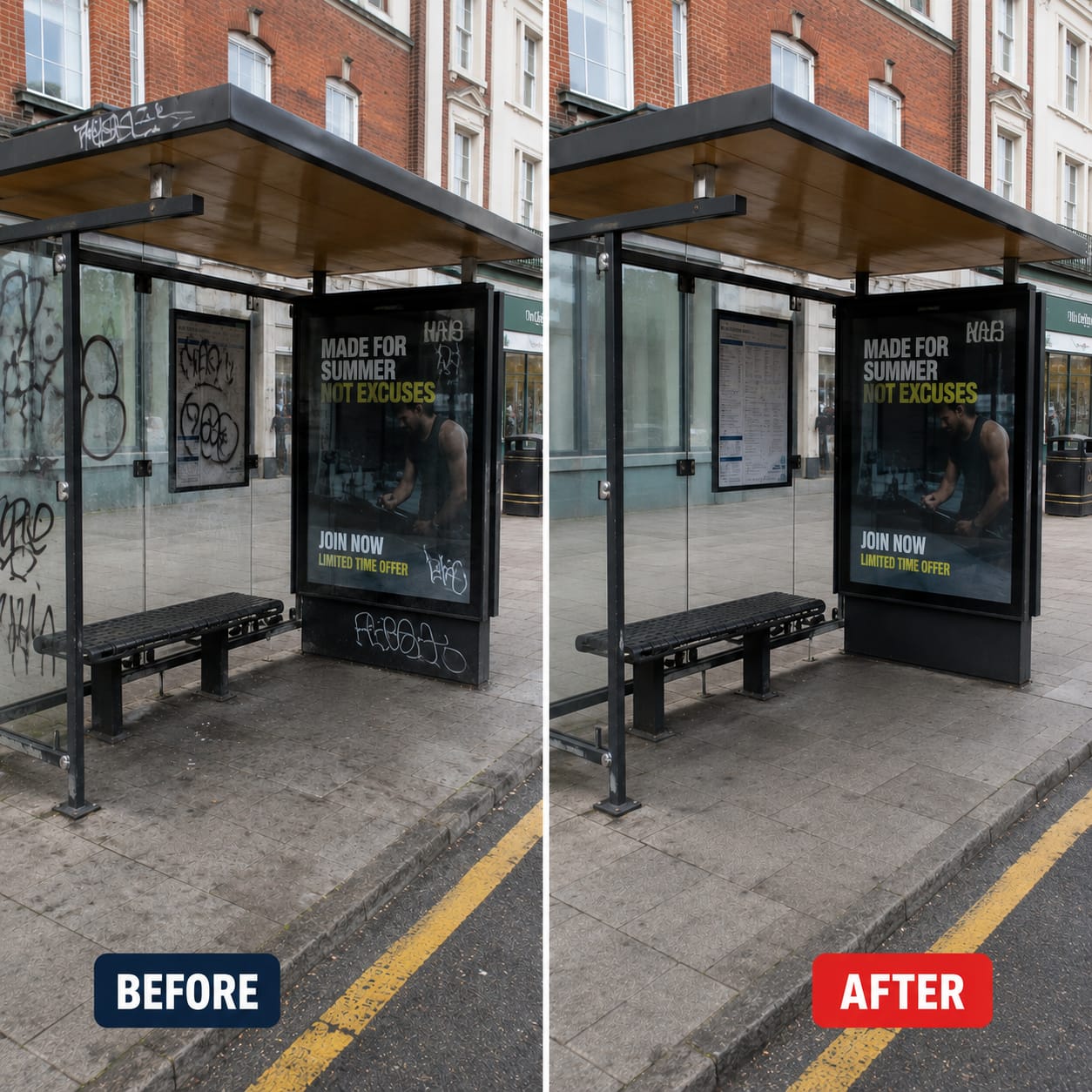
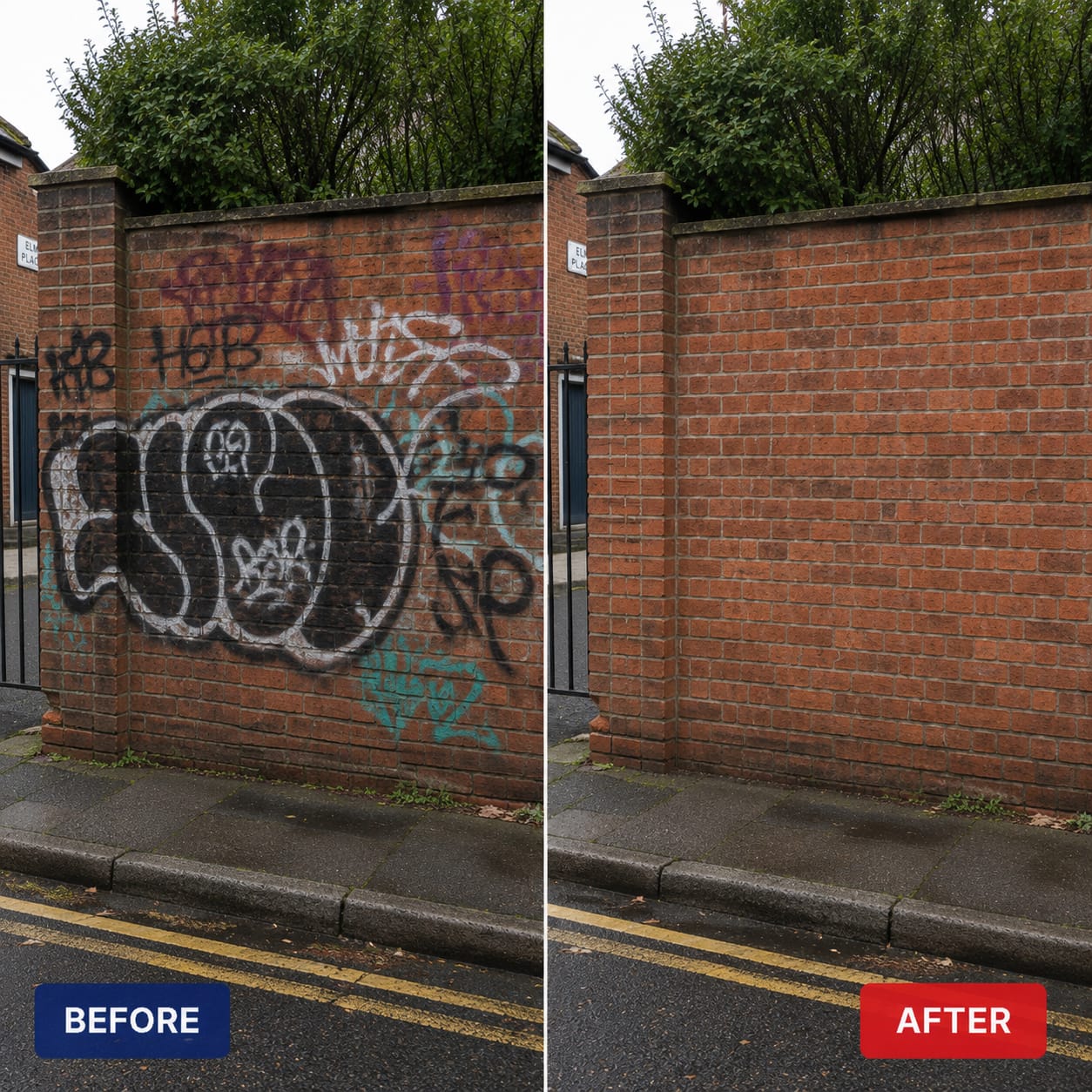
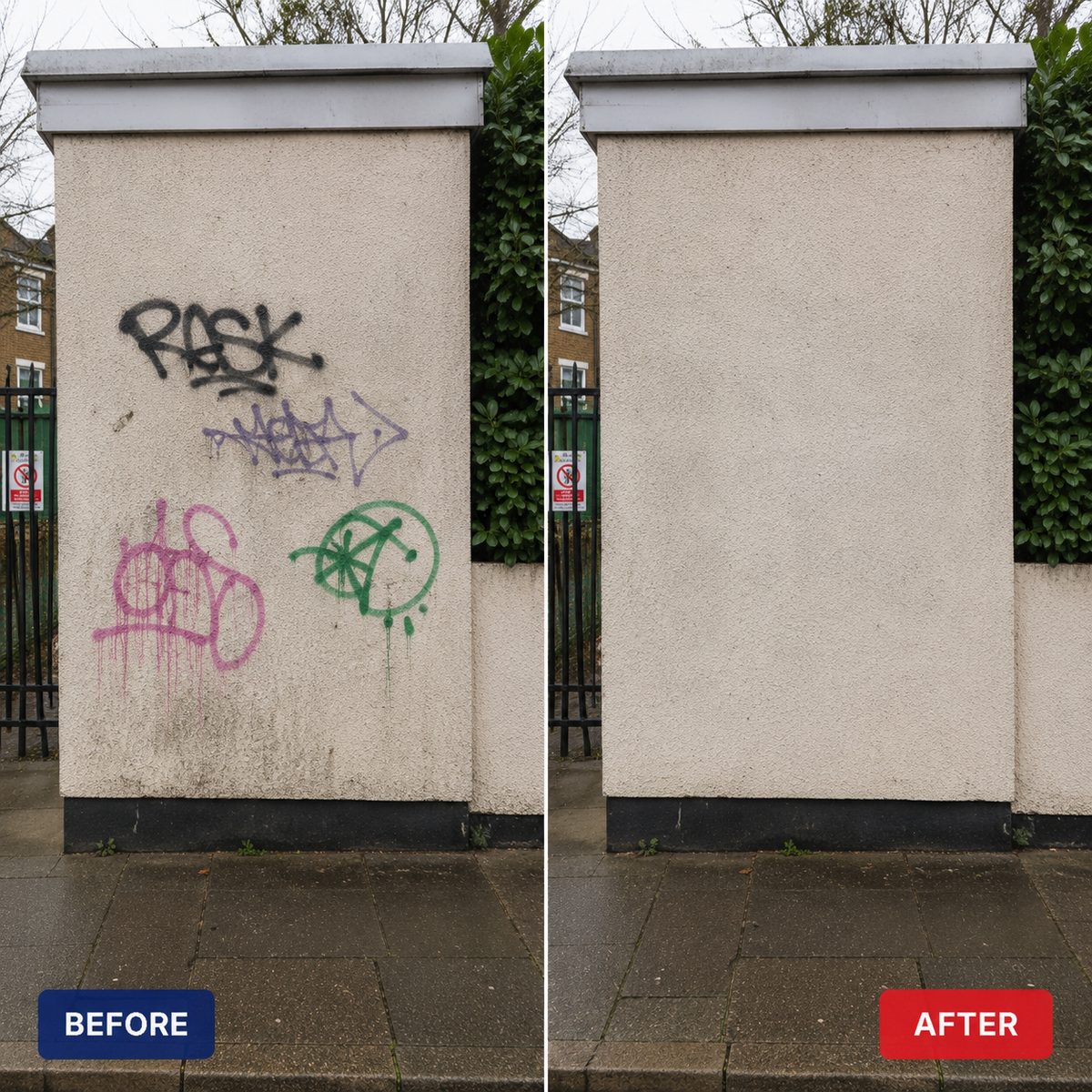
- The approach set the wrong tone. Tagging on the bin store and boundary wall was the first thing visible from the main entrance road.
- Heavy fouling on the entrance canopy. Pigeons had been roosting above the main doors, leaving the walkway beneath stained and unpleasant, and periodically closed for cleaning.
- A car park that looked abandoned after dark. Oil, rubber and traffic film had built up on the decks, and the stairwell was consistently mentioned in patient feedback.
- Nothing could be closed. Ambulance bays, drop-off and accessible parking all had to remain available at all times, which had put off previous contractors.
- Chemicals were a genuine concern. Several elevations sit directly beneath ward windows and ventilation intakes.
The impact of the problem
Exterior appearance was showing up in patient feedback alongside clinical comments, which is a difficult thing to explain internally when the wards themselves are scoring well. There was a safety dimension too: moss on a sloped path to a side entrance had become a slip risk for patients who were already unsteady, and a poorly lit, stained stairwell discouraged people from using the car park at all in the evening.
The solution
Why they chose No Graffiti
The estates team assessed several contractors and selected No Graffiti Ltd on the basis of how the work would be delivered rather than the cleaning itself:
- A worked-out access plan. We proposed working in sections with a written sequence showing which routes stayed open at each stage, rather than asking what could be closed.
- Method chosen for the setting. Chemical-free and low-odour approaches near ward windows and intakes, with stronger products confined to agreed locations and times.
- Water and run-off control. A specific plan for managing wet surfaces on routes used by patients on crutches and in wheelchairs.
- Full accreditation and RAMS. CHAS accreditation, with site-specific method statements covering chemical use and access control.
Implementation: team & resources
The work was phased across several weeks, sequenced so that no part of the site was ever inaccessible.
Phase 1 — Perimeter and bin stores
We started furthest from the clinical areas, removing tagging from the boundary wall, bin stores and service yard. This gave the team a visible improvement on the approach road within the first few days and let both sides settle into the access arrangements before working near the entrance.
Phase 2 — Entrance canopy and walkway
The bird fouling removal was carried out in sections outside peak visiting times, with the walkway sanitised afterwards and a temporary diversion of a few metres rather than a closure. The canopy was cleaned back and the roosting ledges flagged to the estates team for proofing.
Phase 3 — Car park, stairwell and paths
Decks and bays were washed a section at a time, always leaving accessible spaces and the drop-off available. The stairwell was cleaned and the sloped side path treated for moss and algae, which addressed the slip risk as well as the appearance.
The results
The visible change was significant, but the estates team judged the job on whether it caused any operational problem — and it did not.
| Measure | Before | After |
|---|---|---|
| Access routes closed during works | Previous quotes required closures | None |
| Entrance canopy and walkway | Heavily fouled, periodically closed | Cleaned and sanitised |
| Chemicals near ward windows | A blocker to getting work done | Chemical-free methods used |
| Sloped side path | Moss build-up, slip risk | Treated and clear |
| Completion evidence | None | Dated photos for estates records |
On healthcare sites the method is usually decided by what is above and behind the wall — ward windows, air intakes and access routes — rather than by the surface itself.
Client testimonial
“We had been putting this off because every contractor started by telling us what they needed us to close. This was the first quote that came with a plan for keeping everything open. Patients noticed the entrance almost immediately, and the car park no longer comes up in feedback.”
Lessons learned & key takeaways
Three key insights
- The exterior is part of the patient experience. People do not separate the car park from the care, however well the wards score.
- Access planning is the deliverable. On a site that never closes, how the work is sequenced matters more than how it is cleaned.
- Some of it is a safety job. Moss on a sloped path to an entrance is a slip risk for exactly the people least able to absorb a fall.
Advice for others
- Do tell your contractor which windows serve wards or clinical space — it should change what they use and when.
- Do phase the work from the perimeter inwards; it builds confidence before anyone works near an entrance.
- Don't accept a plan that requires closing an ambulance bay or accessible parking. It is nearly always avoidable with sectioning.
Book exterior cleaning for your healthcare site
Need exterior cleaning that fits a live healthcare site?
We work with healthcare organisations across Manchester and the North West — controlled methods, access kept open and documented completion. Tell us about your site and constraints and we'll plan around them.
Frequently asked questions
Can you work without closing access routes?
Yes, and it is the first thing we plan. Ambulance bays, drop-off points, accessible parking and main entrances have to stay usable, so we work in sections and outside peak visiting times where possible. We never leave equipment blocking a route while working elsewhere on site.
What about chemicals near windows and air intakes?
We choose the method with the setting in mind. Near ward windows, ventilation intakes and entrances we favour chemical-free or low-odour approaches, and we manage water and run-off carefully. Where a stronger product is genuinely needed, we agree the location and timing with the estates team first.
Do you provide documentation for inspections?
Yes. Site-specific RAMS are supplied before we attend, and dated before-and-after photographs are provided on completion — both are routinely used by estates teams as evidence of site standards at inspection.
Can you deal with bird fouling as well as graffiti?
Yes. Fouling on canopies, entrance walkways and ledges is common on healthcare sites and we remove it and sanitise the surface afterwards. We will also flag where proofing would stop the problem recurring, though the proofing itself is usually a separate specialist job.