Industrial Pressure Washing in Manchester
Industrial pressure washing and jet washing across Manchester, Greater Manchester and the North West. Warehouse yards, service areas, loading bays, concrete hard standing, plant and industrial estate roadways — cleaned with hot water and the right recovery arrangements.
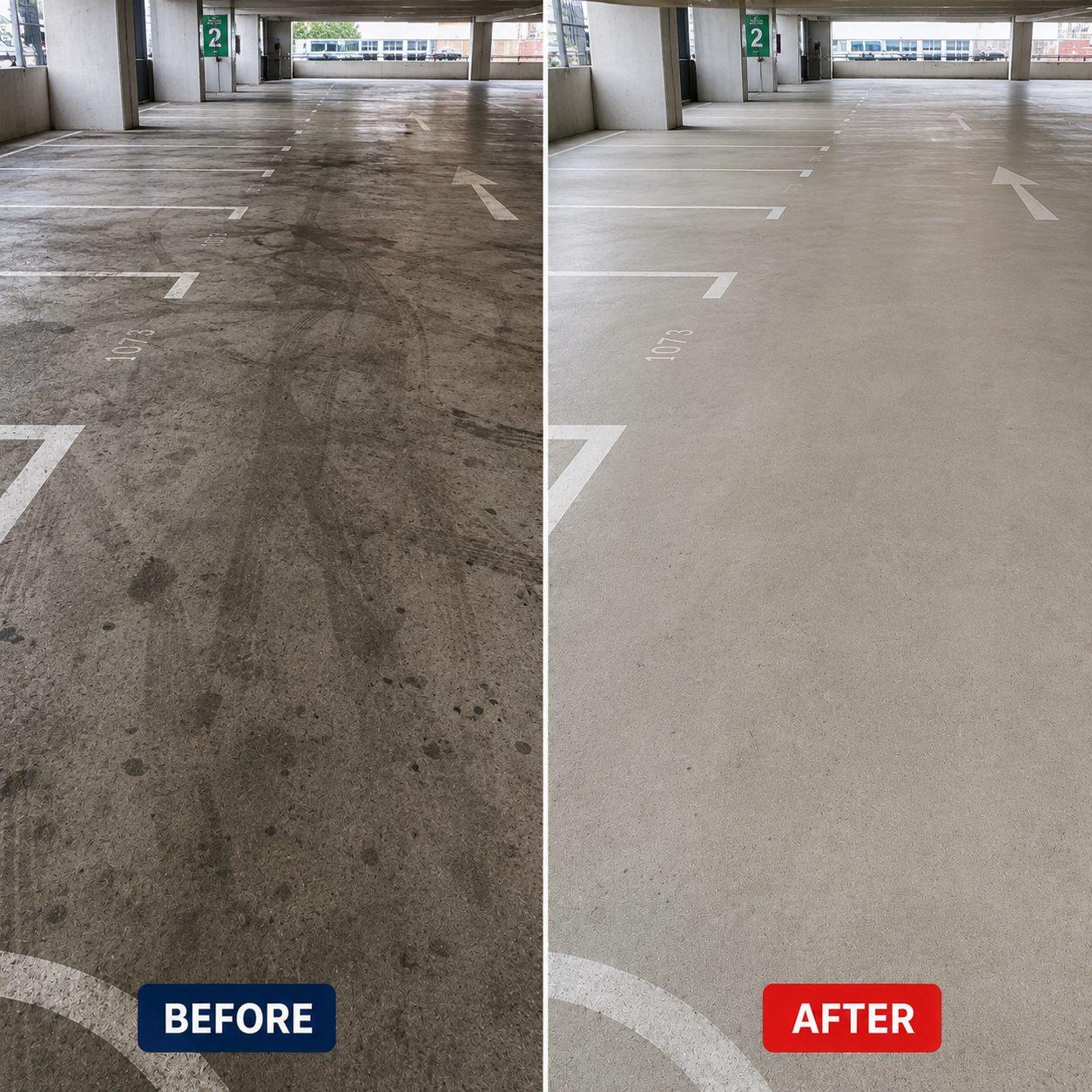
Industrial sites soil differently from commercial ones. An office forecourt collects leaf staining and general grime. A distribution yard collects diesel, hydraulic oil, tyre rubber, brake dust and compacted traffic film, laid down by vehicles that never stop using it. That is a fundamentally different cleaning problem, and cold water and pressure alone will not solve it.
No Graffiti carries out industrial pressure washing across Manchester, Greater Manchester and the North West for warehousing and distribution sites, manufacturing units, industrial estates, depots and plant yards. Our vans run hot-water systems rather than cold, which is the single biggest factor in whether oil-based soiling actually lifts or just gets moved to the edge of the slab.
Why hot water matters on industrial soiling
Most industrial contamination is oil-bound. Diesel, hydraulic fluid, grease, engine oil and the rubber and carbon that traffic grinds into a surface all sit in an oily film that binds to concrete and tarmac. Cold water hits it, and it beads and stays put — so the operator raises the pressure, and now the surface is being eroded while the oil is still there.
Hot water breaks the bond. At the right temperature the oil film releases from the substrate and can be flushed away at moderate pressure, which means the contamination comes off and the slab does not get chewed up in the process. Paired with an appropriate degreasing treatment and enough dwell time, it is what separates a genuinely clean yard from a wet one.
What we clean on industrial sites
- Warehouse and distribution yards, service roads and turning circles
- Loading bays, dock levellers, ramps and approach aprons — see forecourt and yard cleaning
- Concrete hard standing, external slabs and container standing areas
- Industrial estate roadways, parking areas and pedestrian routes
- External plant, tanks, bunds, walkways, steps and handrails
- Building elevations, cladding and roller shutter doors — see render and cladding cleaning
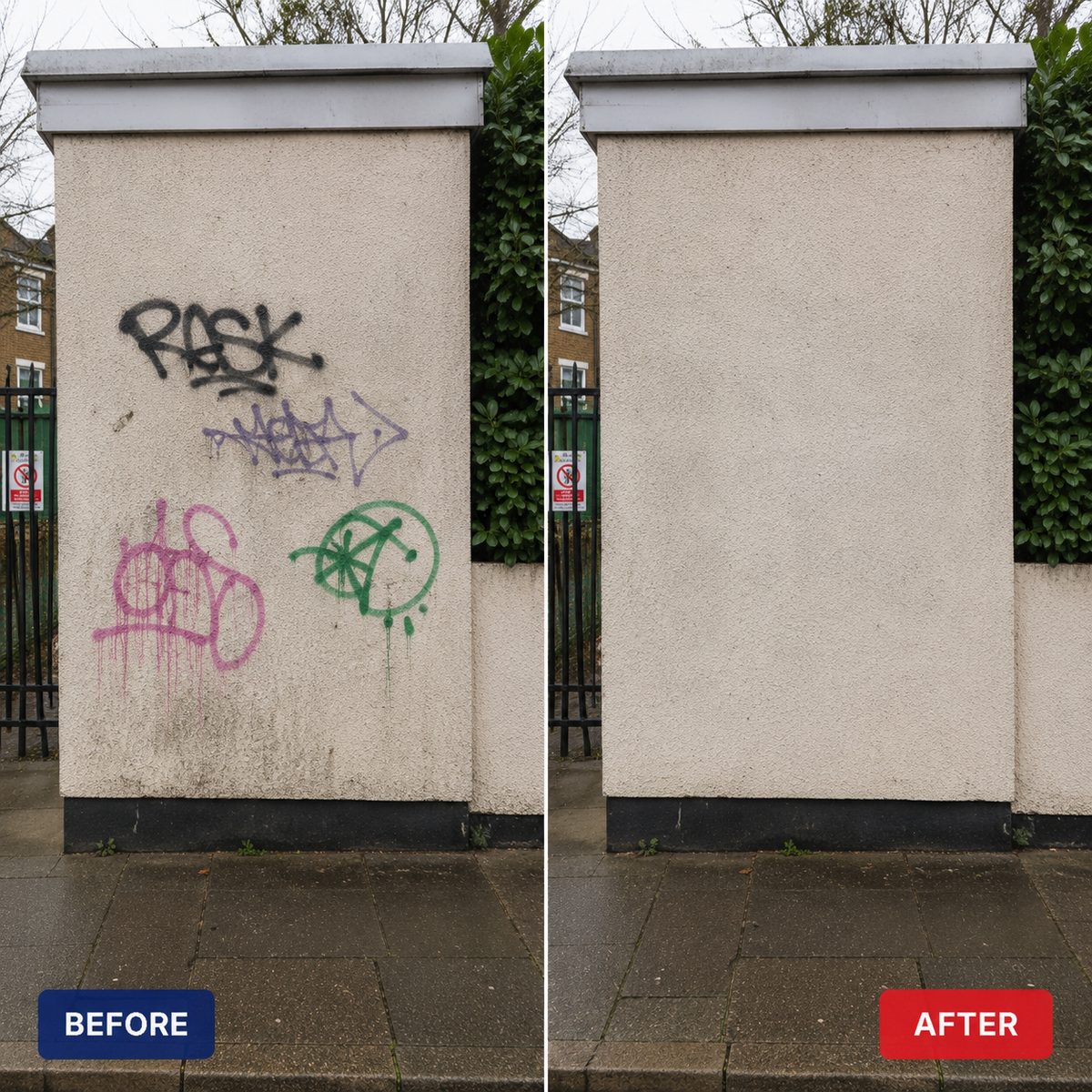
- Perimeter walls, fencing, signage and gatehouses, including graffiti removal where needed
Run-off is the part that gets sites in trouble
On a domestic driveway, nobody thinks about where the water goes. On an industrial site it is the thing most likely to cause a genuine problem, because surface-water drains on most sites discharge to a watercourse — not to treatment. Wash an oily yard into a surface-water gully and you have created a pollution incident, regardless of how clean the concrete looks afterwards.
We plan this before mobilising. Depending on the site that means blocking or bunding surface-water gullies and directing the flow to foul drainage where the site permits it, using wet-vacuum recovery to lift contaminated water for proper disposal, or dry-sweeping and treating heavy contamination before any water is introduced at all. Which approach applies is agreed with your site team and written into the RAMS, not decided by the operative on the morning.
Where a site is close to a canal, river or drainage-sensitive area — common right across the North West's waterway network — we also have chemical-free methods that remove the chemistry from the equation entirely.
Before quoting, tell us where your surface-water drains discharge to and whether there is an interceptor. It changes the method, the cost and the risk more than the size of the area does — and a site that cannot answer it is usually the site that most needs the question asked.
Need an industrial site quoted?
Send photographs, a rough area and a site postcode for a clear price and method statement.
Working around a live operation
Very few industrial sites can hand over a yard for a day. Vehicles are booked in, docks are scheduled, and the cleaning has to fit into the operation rather than the other way round.
In practice that usually means sectioning: we clean in defined bays, with barriers and banksman arrangements agreed with your site team, so movement continues around us. Where sectioning is not workable — a single-access yard, a dock that cannot be closed — we work weekends, planned shutdowns or nights instead. Cleaning a distribution yard between the last despatch and the first intake is routine work for us.
Site rules are followed as written: inductions attended, permits obtained, PPE to your standard, and RAMS and COSHH documentation issued before we arrive rather than produced at the gate.
Planned cleaning beats reactive on industrial sites
Industrial soiling is cumulative and predictable. A yard does not suddenly become dirty; it gets slightly worse every week until someone decides it looks bad enough to do something about. By that point the contamination has had months to work into the surface and the clean is considerably harder and more expensive than it needed to be.
A scheduled programme — quarterly, twice-yearly, or timed to your shutdowns — keeps the surface on top of the contamination rather than always chasing it. It costs less per visit than emergency deep cleans, and it gives facilities and compliance teams a dated photographic record of site condition through the year. Our planned maintenance page covers how these are set up.
Industrial jet washing across Greater Manchester
Warehouse yards, depots, estates and plant — quoted honestly, worked around your operation.
What's Included
Hot water, not just pressure
Our vans run boilers. Hot water lifts oil, grease and traffic film that cold water simply pushes around, which is what most industrial soiling actually is.
Large areas, even finish
A rotary surface cleaner covers hard standing evenly and quickly — no lance striping, no missed lines across a yard.
Contained and controlled
Drain protection and wash-water management planned before we start, which matters on any site where run-off could carry oil or chemicals.
Around production
Weekend, shutdown and night working so a yard, dock or access road can be cleaned without stopping the operation.
Why Choose No Graffiti
- 3,500 psi hot-water systems with 450-litre onboard water — no dependence on your supply
- Fully insured and CHAS accredited, with RAMS and COSHH provided before mobilisation
- 20+ years working to industrial and public-sector site rules
- Photographic evidence per visit for facilities and compliance records
Who We Do This For
Councils & Local Authorities
Housing Associations
Commercial & Facilities
Facilities Management
Maintenance Contractors
Business Improvement Districts
Managing Agents
Transport & Highways
Retail Parks & Shopping Centres
Multi-Site Retail & Hospitality
Shops & Restaurants
Construction & Development
Schools & Academy Trusts
Universities & Colleges
Healthcare
Industrial & Business Parks
Utilities & Telecoms
Homeowners & Landlords
Areas We Cover
We provide industrial pressure washing across Manchester, Greater Manchester and the North West, including:
Frequently Asked Questions
Can you remove oil and diesel staining?
Usually a substantial improvement, and often complete removal on sealed concrete. Fresh spills lift well with hot water and a degreasing treatment. Oil that has soaked into unsealed, porous concrete over years has penetrated the slab, and while we can pull a great deal of it out with poulticing, we will tell you honestly before starting if a full removal is unlikely.
What about the wash water?
We plan it before the job. Depending on the site and what is being cleaned, that means drain protection, directing run-off to foul rather than surface-water drains where appropriate, or wet-vacuum recovery. Industrial run-off can carry oil, fuel and detergent, so this is agreed as part of the RAMS rather than improvised.
Do you need our water and power?
No. The vans carry their own 450-litre tanks, boilers and generators, so we are self-sufficient on site. If a site supply is available and easier we will happily use it, but we do not depend on it.
Can you work outside production hours?
Yes. Most industrial jet washing we do is scheduled around the operation — weekends, planned shutdowns, night shifts or the gap between despatch finishing and the next intake.
Ready for your procurement process
- CHAS accreditedHealth & safety prequalified
- Fully insuredPublic & employers' liability
- RAMS & COSHHSupplied before mobilisation
- 20+ yearsCouncil & housing experience
- Rapid responsePriority on offensive graffiti
Insurance certificates, RAMS, COSHH assessments and method statements available on request — ask and we'll send the pack.
Need graffiti gone — fast?
Call 0161 399 5247 or request a free quote. We respond within one working hour.